
How to Make Money With Google Without a Website

This short guide explains practical routes to earn online without owning a traditional site. You can earn creator revenue from platforms Google supports, or run ads that send traffic to hosted pages and partner platforms.

Set realistic expectations: this is a step-by-step, informational piece focused on actions you can take in the United States with limited time. It is not hype.

We preview three core pathways: YouTube monetization, app income via AdMob, and paid ad campaigns that don’t require a personal site. Each path needs a Google account, a content plan, and simple tracking to see what works.

At a high level, creators earn when ads show to viewers, and businesses earn when ads convert to sales or leads. AdSense pays out after earnings exceed USD $100, and ad campaign returns depend on smart optimization.

Key Takeaways

  • You can earn without a site by using YouTube, apps, or hosted landing pages.
  • Start small: test one path, measure results, then scale what works.
  • Foundational setup requires an account, a plan, and basic metrics.
  • Creator revenue comes from ads; business returns come from conversions.
  • AdSense pays after $100; ad campaign success needs ongoing optimization.

What “Without a Website” Really Means and What You Need to Start

Not having a standalone website doesn’t mean you lack a place to host content or offers. In practice, “without a website” means you use platform-hosted destinations: a YouTube channel, an app listing, a marketplace storefront, or a hosted landing page where users engage with your content and offer.

Choosing your monetization path: creator revenue vs. advertiser profit

Creator revenue comes from publishing content where ads appear and you earn revenue when viewers engage. Advertiser profit means you run google ads, pay per click or impression, and profit when conversions exceed spend. Match the path to your business goals: steady creator income or campaign-driven returns.

Core setup essentials: Google account, niche, content, and audience

  • Google account: secured, verified, and linked to the platform you’ll use.
  • Niche and content workflow: pick a clear topic and a repeatable production plan.
  • Audience plan: map how people search and build content that answers their intent.

How the ad auction connects advertisers, keywords, and your content

Advertisers bid in an auction for placements. Google matches ads to context and user intent. Higher-value niches, better relevance, and stronger keywords raise potential earnings for publishers and improve results for advertisers.

“AdSense is the publisher earning model; Google Ads is the advertiser spending model.”

Guardrails: follow platform policies and keep content quality high. Policy compliance affects monetization eligibility and long-term results, so prioritize clear, honest content and user-first design.

How to make money with Google Using YouTube Content

Build a repeatable content engine: niche focus, publishing rhythm, and smart metadata drive sustainable views.

Getting eligible for the YouTube Partner Program and turning on ads

Start by picking a clear niche and publishing consistent videos. Aim for the platform’s eligibility thresholds (channels often need thousands of cumulative views—the common milestone cited is 10,000) and link an AdSense account to enable monetization.

Video topics that match search intent and attract higher-value advertisers

Choose topics by user intent: informational for discovery, comparison for consideration, and buyer-intent for higher ad rates. Higher-value advertisers bid more in niches tied to purchases or services.

Ad formats that impact revenue: skippable video, display, and overlays

Ads on YouTube include skippable video, display placements, and overlays. Longer watch time and strong retention create more ad opportunities and often raise the potential revenue per channel.

Boosting views and watch time with Google Search visibility and metadata

  • Titles: match real queries
  • Descriptions: answer fast and link chapters
  • Timestamps & tags: improve semantic coverage without stuffing

Use simple SEO thinking: better search results impressions and suggested placements lead to more views. Track performance in YouTube Studio and iterate thumbnails, titles, and batch content production to start earning steadily.

“Revenue varies by topic, region, seasonality, and advertiser demand.”

Earn App Revenue With Google AdMob Without Owning Any Websites

A simple SDK integration turns an app into a monetization channel that doesn’t need a separate site. Integrate AdMob, request ads inside the app, and you earn when users view or interact with ads. Demand comes from large advertisers and many networks, so apps can tap broad ad supply without a website.
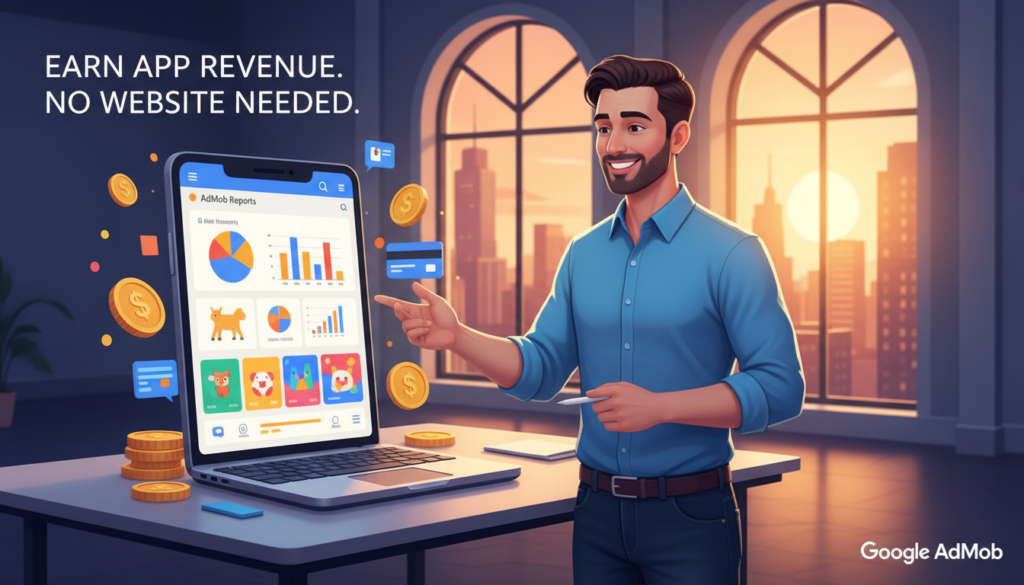
A vibrant digital workspace showcasing the concept of earning app revenue through Google AdMob. In the foreground, a modern smartphone displays colorful app advertisements featuring playful graphics. Surrounding the phone are various financial symbols like coins and dollar signs, hinting at revenue generation. The middle ground includes an upbeat professional, dressed in smart casual attire, analyzing app metrics on a laptop. The background features a sleek office environment with soft, warm lighting that creates an inviting atmosphere. A large window reveals a city skyline bathed in golden hour sunlight, adding depth to the scene. The overall mood is optimistic and entrepreneurial, emphasizing the potential for success without needing a website.

How AdMob monetization works for creators and app businesses

AdMob serves ads inside apps after you add the SDK and request placements. Ad networks and advertisers bid to fill impressions, and your app earns a share of that value.

High-performing ad formats

Rewarded: opt-in exchanges, great for games. Native: blends into UI. Banner: persistent but low CPM. Interstitial: fits transitions. Video: high-value impressions for engaged users.

Maximizing fill rate and CPM

Fill rate means how often requests return paid ads. CPM is the value per thousand impressions. Higher fill rate and CPM raise overall revenue.

Mediation, bidding, and brand safety controls

Mediation lets multiple networks compete. Bidding runs real-time auctions so the top bid wins. Brand safety controls keep ads aligned to your app and protect user trust.

Tracking and realistic expectations

Use AdMob reporting and Google Analytics for Firebase to link acquisition, retention, and monetization data. Results vary by region, device, category, and seasonality—treat estimates as directional, not guaranteed.

“AdMob powers apps at scale: over 1M apps use it and most top Android apps rely on the network.”

Make Money Using Google Ads Without a Website by Sending Traffic to Hosted Pages

You can run targeted ad campaigns that route traffic to storefronts, listings, or hosted landing pages instead of a site. This approach uses paid placements to drive users to platform-hosted pages where conversions happen.

A modern office scene depicting a professional in business attire, seated at a sleek desk with a laptop open, displaying a Google Ads dashboard filled with various ad campaigns. In the foreground, a notepad filled with marketing strategies and insights. The middle ground features a large window with a view of a bustling city skyline, symbolizing limitless opportunities. Soft, natural lighting floods the room, creating a warm atmosphere that inspires productivity. The background includes potted plants and modern decor, emphasizing a contemporary workspace. The overall mood is vibrant yet focused, capturing the essence of making money online through Google Ads without requiring a personal website. The image should have a clean composition, with no text or logos present.

Google AdSense vs. Google Ads

google adsense is the publisher model: publishers earn when automated ads appear on their content. google ads is the advertiser model: you pay to bid on placements and only profit when conversions exceed cost.

Where to send traffic (no-site destinations)

Use marketplaces and creator pages that work in the United States:

  • Amazon, Etsy, or ebay product listings
  • Gumroad/Payhip product pages or creator storefronts
  • YouTube videos or playlists and Google Business Profile listings
  • Platform-hosted landing pages from reputable builders

Campaigns, keywords, and relevance

Message match between keyword → ad copy → hosted page is the top lever to lift conversions and cut wasted traffic. Focus on buyer-intent search phrases and tight match types to protect your budget.

Negative keywords and ad extensions

Review search term reports weekly and exclude irrelevant queries. Use sitelinks, call, and location extensions to boost visibility and CTR.

Targeting and measurement

Geotarget by state, city, or ZIP and use in-market audiences for higher intent. Define conversions on the hosted page, add platform pixels where possible, and run disciplined A/B tests.

“Savvy campaigns can exceed $2 earned per $1 spent, but results depend on offer quality and execution.”

Conclusion

Pick one clear path and focus: publish on YouTube, monetize an app with AdMob, or run google ads to hosted pages. Each route can help you earn revenue, but each needs different skills and time.

Remember: “no website” does not mean no system. You still need content, an offer, measurement tools, and a plan to reach users through a search engine and platform distribution.

Quick decision guide: creators who enjoy publishing should favor YouTube. Product people who want faster tests can use google ads. Builders should test ad monetization inside apps.

Set realistic expectations: ad auctions and advertiser bids shape results. Start small, measure weekly, iterate, and keep learning official docs and policy updates to improve outcomes.

FAQ

How can I earn revenue without owning a website?

You can generate income by publishing on platforms Google supports, such as YouTube, Android apps using AdMob, or by driving traffic to hosted storefronts and marketplace listings. Each path connects your content or app to advertisers and users through Google’s ad systems and search visibility.

What does “without a website” really mean and what do I need to start?

It means you don’t need to build or host a traditional site. You still need a Google account, a clear niche, consistent content or an app, and an audience. Pick a monetization path—creator revenue (YouTube, apps) or advertiser profit (campaigns to hosted pages)—and prepare metadata, thumbnails, or store listings that match search intent.

How does Google’s ad auction link advertisers, keywords, and my content?

Advertisers bid on keywords and user signals; Google’s auction ranks ads by bid and quality. Higher relevance between user queries, your content, and the advertiser’s landing page improves ad quality and CPMs, which raises potential payouts for creators and publishers.

How do I get eligible for the YouTube Partner Program and enable ads?

Meet YouTube’s thresholds (subscriber and watch-time requirements), follow community guidelines, and link an approved AdSense account. Once accepted, activate ad formats in YouTube Studio and follow copyright and advertiser-friendly rules to keep monetization active.

What video topics attract higher-value advertisers?

Topics with clear buyer intent—finance, tech, health, and software—often draw higher CPMs. Tutorials, product reviews, and long-form explainers that match search queries tend to attract advertisers willing to pay more per view or click.

Which ad formats on YouTube most affect revenue?

Skippable video ads, non-skippable ads, display overlays, and sponsored cards each impact earnings differently. Skippable ads can deliver higher overall revenue with strong watch time, while non-skippable ads pay more per impression but can hurt retention if overused.

How do I improve views and watch time using Google Search visibility?

Optimize titles, descriptions, and tags to match search intent and target keywords. Use compelling thumbnails and playlists to increase session length. Cross-post content and add timestamps so search snippets show relevant sections that increase clicks.

How does AdMob monetization work for app creators and businesses?

AdMob serves ads inside apps and shares revenue with developers. You integrate the SDK, choose ad formats, and configure mediation or bidding. Ad impressions and clicks generate earnings based on region, ad demand, and user engagement.

Which AdMob ad formats perform best?

Rewarded ads, native ads, interstitials, banner, and rewarded video often perform well. Rewarded formats typically yield higher engagement and retention, while native ads blend with app content for better click-through and user experience.

How can I maximize fill rate and CPM in AdMob?

Use mediation and bidding to pool demand sources, enable brand safety settings, and segment traffic by region and device. Test ad placement and frequency, and integrate Google Analytics for Firebase to monitor user behavior that affects ad value.

How do I track AdMob performance and link it to Firebase?

Enable AdMob reporting and connect your AdMob account to Google Analytics for Firebase. This provides event-level insights, retention metrics, and revenue attribution to help optimize ad placements and user funnels.

What revenue expectations should I set for apps and why do results vary?

Revenue varies by region, device, category, and seasonality. Niche apps with engaged users and rewarded ad formats tend to earn more. Start modestly, track CPMs and fill rates, and scale through optimization and marketing to improve results.

Can I run Google Ads without a website and still get conversions?

Yes. Send traffic to hosted pages like marketplace listings, creator storefronts, or platform-hosted landing pages. The key is strong campaign-to-page relevance so ads match the destination and user intent, which improves conversions and lowers wasted spend.

What’s the difference between Google AdSense and Google Ads?

AdSense pays publishers for hosting ads on their content, while Google Ads is the platform advertisers use to pay for clicks, views, or conversions. If you don’t own a site, you act more like a publisher on platforms (YouTube, apps) or an advertiser using Google Ads to promote hosted pages.

How do I choose a no-site destination for ads?

Pick marketplaces, creator storefronts, or platform-hosted landing pages that match buyer intent and offer clear conversion paths. Ensure the destination supports tracking and provides product or service details that align with your ad copy and keywords.

What keyword strategy works best for ads that point to hosted pages?

Focus on buyer-intent keywords and use match types to control reach. Monitor search terms to find missed opportunities and add negatives to filter irrelevant traffic. Prioritize long-tail queries that show intent to purchase or subscribe.

How do negative keywords protect my budget?

Negative keywords prevent ads from showing on irrelevant searches. By excluding unrelated or low-converting phrases, you reduce wasted clicks and improve overall ROI. Review search term reports regularly to refine negatives.

Which ad extensions boost visibility for non-site campaigns?

Use call, location, and sitelink extensions where applicable. Even if you don’t link to a website, extensions provide extra info and actions—like phone calls or links to store listings—that increase CTR and lead quality.

How can geotargeting and audience segmentation improve campaign performance in the United States?

Narrow targeting by state, city, or ZIP and layer in demographic or interest audiences to reach users most likely to convert. This reduces wasted spend and lets you tailor ad copy and bids to high-value segments.

How do I measure ROI for campaigns that send traffic to hosted pages?

Track conversions using platform pixels, phone call tracking, or marketplace analytics. Run A/B tests on creatives and landing destinations, monitor cost per acquisition, and set realistic expectations based on industry benchmarks.

What daily optimization practices should I follow to improve ad performance?

Review performance metrics each day, pause low-performing keywords or placements, adjust bids based on ROI, and test new creatives. Small, consistent changes compound into better results over time.

Are there legal or policy rules I must follow when monetizing through Google platforms?

Yes. Follow platform-specific policies—YouTube community guidelines, AdMob content rules, and Google Ads policies on ad content. Violations can suspend monetization or accounts, so review policies regularly.
Scroll to Top